My TGS


At The Gower School, the Montessori ethos informs our curriculum and classrooms for inspirational learning.
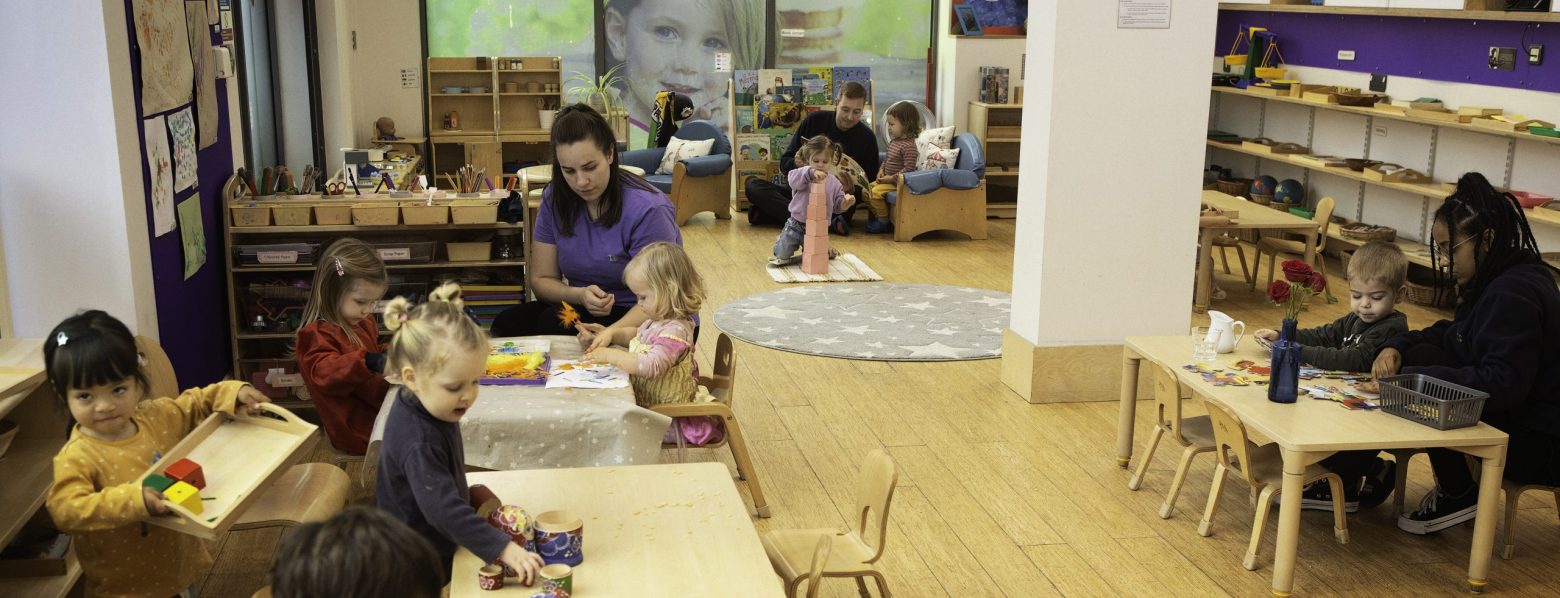
The Montessori classroom is divided into several areas by low, open shelves: one for Practical Life exercises, one for Sensorial, one for Language, another for Maths and other areas for Culture – art, music, geography and science.
The Montessori curriculum is an integrated, thematic approach that ties the separate disciplines together into studies of the physical universe, the world of nature and human experience. In this way, one lesson leads to many others.
Each material or activity in the classroom isolates one concept or skill. They have been designed especially so that the children are drawn naturally to want to work with them with little or no nudging from adults. Additionally, they are designed so that a child can check their own work; we call this a built-in “control of error”. Truly, the intention of the materials is not to keep the children dependent on these artificial learning aids forever; they are used as tools to help children work and learn at their own pace, to see abstract ideas presented in a very concrete, three-dimensional way and to help them grasp and understand what they are working on.
Dr. Montessori saw the senses as the “doorway to the mind.” She considered sensory manipulation an aid to the development of the sense organs (eyes, ears, nose, tongue and skin) and a starting point for intellectual growth. She believed that by learning to order, compare and classify sensory stimulation, children would intellectually develop. They would carry on this knowledge to future learning, and apply their sensory understanding in meaningful and useful ways.
The basic sensorial exercise draws attention to specific qualities in material objects, and to classify similarities and contrasts. The mind must judge, compare and draw conclusions. These exercises fascinate children and are difficult enough to represent a meaningful challenge. Children are then better prepared for future learning in maths, language and science. They make sense of life’s experiences and information.
The central purpose of the Maths materials in the early years is to lay the foundation for later cognitive development. Additionally, it helps prepare for the gradual transition to abstract thinking. Activities in mathematics transform ideas into actions using concrete materials. Students who learn maths by rote methods often have no real understanding to use it in everyday life. Montessori students use hands-on learning materials that make abstract concepts clear and real.
The Montessori maths curriculum is based on the European tradition of ‘Unified Maths’. Unified Maths introduces elementary students to the fundamentals of algebra, geometry, logic and statistics, along with the principle of arithmetic. This study continues over the years, weaving together subjects with other areas of learning.
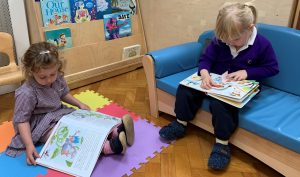
Language development is a key issue in the entire Montessori classroom. Our activities foster vocabulary development, communication skills, writing and reading-readiness. We use a large variety of materials for phonetic analysis, word-attack skills and reading, as well as materials for the refinement of fine motor control (the pincer grip for holding a pencil) for writing.
In the Montessori Method, writing precedes reading as the children explore with drawing and forming letters. Learning how to read should be as painless and simple as learning how to speak. The child begins by exploring the sounds that words are composed of and relating them to the letters of the alphabet. They can soon produce words and sentences free of all other mechanical difficulties. In the meantime, they train their hand to become precise for writing movements. Reading is prepared indirectly from writing.
We give children the key to read all the words they will encounter- the phonic alphabet. Students tend to exhibit a sudden “reading explosion”, which leaves the children and their families beaming with pride.
Dr. Montessori’s research confirmed what observant parents have always known: that children learn best by touch and manipulation, not by repeating what they are told.
Science is an integral element of the Montessori curriculum. It represents a clear-thinking approach to gathering information and problem-solving. The Montessori science curriculum includes an introduction to botany, zoology, chemistry, physics, geology and astronomy. The Montessori approach cultivates children’s fascination with the universe and helps them develop a lifelong interest in observing nature and discovering the world.
Our teachers introduce history and geography as early as age three. The youngest students work with specially-designed maps to learn the names of the world’s continents and countries. Later, in primary school, the students look at the world’s cultures in greater depth. They learn to treasure the richness of their own cultural heritage and those of their friends.
Music and movement are important parts of the curriculum, along with the arts. They offer children ways of expressing themselves, their feelings, experiences and ideas. Montessori schools are very interested in helping children develop control of their fine and gross-motor movement.
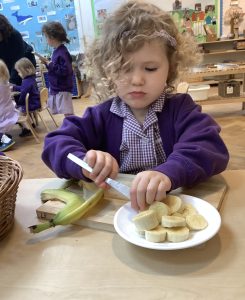
Practical Life is designed to invite the young learner to act and work on real-life tasks. This fosters independence, co-ordination, order and concentration. It is, in a sense, the doorway to the Montessori curriculum.
The Practical Life area is where a child may first choose independent work. This area contains many attractively-displayed objects familiar to the child. These include a variety of items used in daily life for eating, dressing and cleaning.
They offer the child meaningful modes of activity. The materials are also designed to help teach skills involved with caring for the themselves and the environment. Additionally, they encourage responsibility and autonomy, and promote high self-esteem.